Etihad Airways is not simply adding more dots to its Africa map. It is building a much more deliberate bridge between Africa and Asia through Zayed International Airport in Abu Dhabi (AUH), using a mix of widebody capacity, cargo relevance, and carefully chosen economic centers rather than a scattershot network expansion.
The airline’s latest move adds six African destinations to the Abu Dhabi map between November 2026 and March 2027: Kotoka International Airport in Accra (ACC), Asmara International Airport (ASM), Murtala Muhammed International Airport in Lagos (LOS), N’djili International Airport in Kinshasa (FIH), Lubumbashi International Airport (FBM), and Robert Gabriel Mugabe International Airport in Harare (HRE). Frequencies range from three weekly to daily, with Lagos (LOS) receiving the strongest commitment at seven flights a week.
That matters because this is not a purely Africa-facing expansion. Etihad is clearly designing these services to feed beyond the Gulf. The airline has openly tied the move to its recent China growth and to Abu Dhabi’s role as a transfer point between Africa, India, and wider Asia. In other words, this is less about serving isolated origin-and-destination markets and more about building a usable corridor.
This is six destinations, but not six identical launches
The rollout is structured in two waves.
Asmara International Airport (ASM) comes first, launching on November 7, 2026 with four weekly flights from Abu Dhabi (AUH). Then comes the larger March 2027 push: Accra (ACC) begins on March 17 with four weekly flights, Kinshasa (FIH) and Lagos (LOS) both launch on March 18, and Harare (HRE) plus Lubumbashi (FBM) follow on March 24. The route design is where the strategy becomes more interesting. Kinshasa (FIH) gets its own nonstop service from Abu Dhabi (AUH), but Lubumbashi (FBM) does not. Instead, Etihad will operate a triangular routing via Harare (HRE), flying Abu Dhabi–Harare–Lubumbashi–Abu Dhabi three times weekly. That is an important distinction. It shows Etihad is not treating all six additions as equal standalone markets. Some are clearly strong enough to support their own nonstop profile; others are being paired in a way that spreads risk while still giving the airline presence in commercially useful places.
Lagos (LOS), by contrast, is the big volume play. A daily service tells you immediately that Etihad sees Nigeria’s commercial capital as more than a niche long-haul add. It is a core African gateway in the making.
Asmara (ASM) will be served by the Airbus A320, a much smaller and more flexible aircraft than the Boeing 787-9 Etihad is assigning to the rest of the African expansion. That is a sensible match. Asmara is the kind of market where frequency and presence may matter more than sheer gauge, and the A320 lets Etihad enter the route with lower trip cost and less capacity risk.
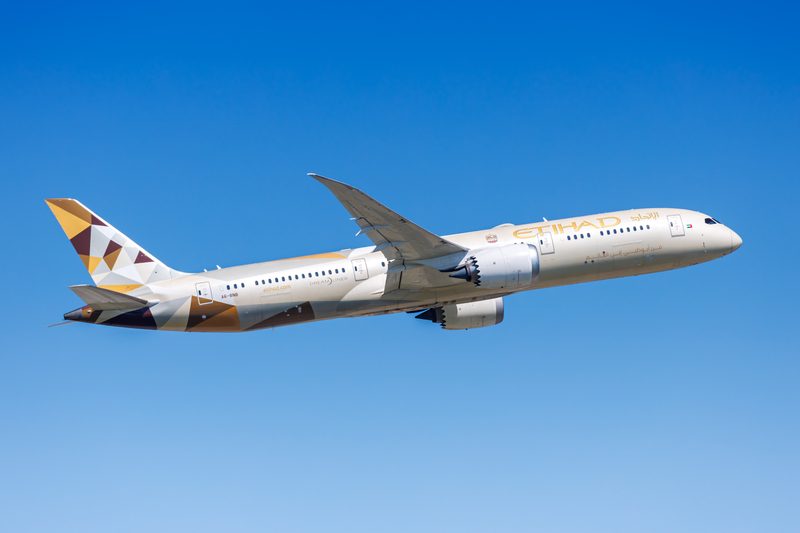
The rest of the new African push is more widebody-led. Accra (ACC), Kinshasa (FIH), Lagos (LOS), and the Harare (HRE)–Lubumbashi (FBM) rotation are all scheduled with the Boeing 787-9. In Etihad’s current long-haul configuration, that means 28 Business seats and 262 Economy seats, giving the airline a 290-seat platform with a meaningful premium cabin and enough lower-deck capacity to make cargo matter as well.
That is the real significance of the aircraft plan. Etihad is not launching these markets with a narrowbody-first mentality, apart from Asmara. It is entering much of Africa with a widebody that can carry premium demand, transfer traffic, and freight in one package. For markets such as Lagos (LOS), Accra (ACC), and Kinshasa (FIH), that is a strong statement of intent.
The DRC move is especially telling
The two Democratic Republic of the Congo points, Kinshasa (FIH) and Lubumbashi (FBM), are arguably the most revealing part of the announcement. This is not leisure flying. It is trade-and-project flying.
Kinshasa is a major Central African capital with political, diplomatic, and commercial importance. Lubumbashi, meanwhile, sits in the heart of the DRC’s mining economy and is closely tied to copper and cobalt flows out of Haut-Katanga. Adding both points tells you Etihad is looking well beyond traditional Gulf leisure patterns. It is targeting markets where cargo, business travel, infrastructure investment, and extractive-industry traffic all matter.
That same logic extends to Harare (HRE). Pairing Harare with Lubumbashi on the same routing gives Etihad exposure to two different southern and central African business markets without forcing each city to carry the full economics of an independent daily nonstop.
This is really an Africa-to-Asia play routed through AUH
Etihad’s own wording leaves little doubt about the bigger objective. The airline has explicitly linked the African expansion to its recent China build-up, and that connection matters.
Just days ago, Etihad announced a major increase in mainland China flying, lifting the network to 35 weekly services across six Chinese gateways. That is not background noise. It is the other half of the strategy. If you add more capacity into China while also widening your reach in West, Central, East, and Southern Africa, Abu Dhabi (AUH) starts to look less like a hub serving two separate regions and more like a purpose-built bridge between them.
That is why cargo sits so prominently in the announcement. Etihad is not talking only about passengers. It is talking about manufacturing, agriculture, pharmaceuticals, infrastructure, and other trade-linked sectors where time, route reliability, and usable belly-hold capacity can make a route much more valuable than its local passenger numbers alone would suggest.
The airline’s partnership structure supports that interpretation as well. Its joint venture with China Eastern Airlines strengthens the China end of the corridor, while its Ethiopian Airlines partnership expands African access and helps build broader connectivity between Africa, the Middle East, Asia, and beyond.
Abu Dhabi is being positioned as the connector, not just the origin
That may be the most important point for airline professionals.
This is not simply Etihad growing because it can. It is Etihad trying to make Abu Dhabi (AUH) more indispensable in flows that do not begin or end in the UAE. That is a very Gulf-carrier strategy, but the execution here is notably targeted. West Africa gets Lagos (LOS) and Accra (ACC). East Africa gets Asmara (ASM), alongside the existing Ethiopian relationship. Central Africa gets Kinshasa (FIH). Southern and mining-linked flows get Harare (HRE) and Lubumbashi (FBM).
In network terms, that is a more interesting map than a purely tourism-led African expansion. It suggests Etihad is prioritizing markets that can support a mix of passenger, cargo, and transfer relevance, rather than just chasing headline destination count.
Bottom Line
Etihad’s Africa push is not just bigger. It is more strategic than it first appears.
The airline is adding six African destinations from Zayed International Airport (AUH), but the real story lies in how they are being launched. Asmara (ASM) comes in on the Airbus A320, signaling a cautious, right-sized entry. Lagos (LOS), Accra (ACC), Kinshasa (FIH), and the Harare (HRE)–Lubumbashi (FBM) operation come in on the Boeing 787-9, showing that Etihad sees real premium and cargo potential in these markets.
Most importantly, this is not an Africa-only expansion. It is an Africa-to-Asia corridor play, timed to follow Etihad’s China growth and supported by partnership structures on both ends of the network. For Etihad, the bet is clear: Abu Dhabi (AUH) can become a more powerful connector between two fast-growing regions, and Africa is the next major piece of that puzzle.